

Comprehensive Hotel SOPs for Storms, Tornados: A 2026 Crisis Management Guide
Hotel Emergency Standard Operating Procedure (SOP) for Storms & Tornadoes
Quick Answer: Effective hotel standard operating procedures for severe weather require immediate multi-channel guest notification, mandatory elevator lockdowns, and the rapid relocation of guests to designated interior sheltering zones. Successful crisis management shifts all staff into active response roles to guide occupants away from exterior walls and wind-tunnel hallways to pre-marked, lower-level safe areas.
Key Takeaways
- Relying on outdoor municipal sirens is insufficient; hotels must use multi-channel internal alerts to wake and inform guests.
- Elevators must be strictly prohibited during active warnings to prevent guests from becoming trapped during power outages.
- Open hallways with doors or windows at both ends act as dangerous wind tunnels and should never be used as shelter areas.
- The safest locations are on the lowest practical level in interior rooms, such as windowless conference rooms, bathrooms, or reinforced closets.
- If guests cannot evacuate their rooms, they must shelter in the interior bathroom, close all drapes, and use mattresses to protect against flying debris.
- Staff roles must automatically shift from standard hospitality duties to emergency response protocols the moment a warning is issued.
Why Specialized Hotel SOPs for Storms, Tornados Are Critical
Relying on a building’s concrete exterior to protect hundreds of sleeping guests during a severe weather event is a critical operational failure. Commercial lodging facilities present unique dangers during high-wind events due to their heavy use of structural glass, complex multi-story layouts, and transient populations who are entirely unfamiliar with the local geography.
When a severe storm or tornado approaches, time is the most valuable asset. The Federal Emergency Management Agency (FEMA) advises travelers to review a hotel’s specific tornado emergency plan with management and staff immediately upon check-in, explicitly noting that hotels are not automatically safe without a designated lower-level shelter area [8]. Without a documented and rehearsed set of Standard Operating Procedures (SOPs), staff panic and guest confusion will compound the physical dangers of the storm.
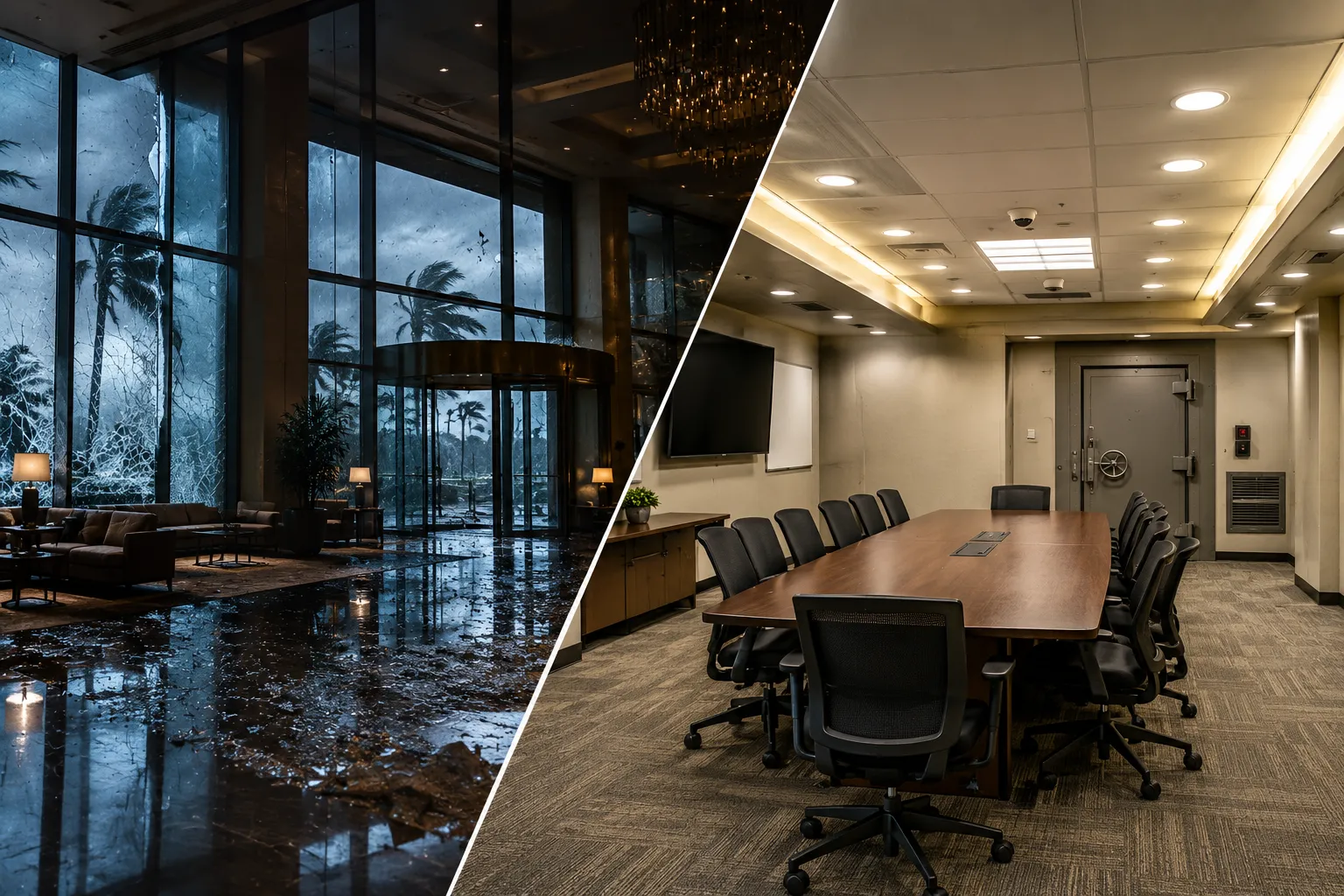
A comprehensive crisis management strategy requires a written emergency plan where staff roles, including the front desk, housekeeping, and engineering departments, are explicitly shifted into response mode to account for guests and guide them to preassigned shelter areas [5].
Pre-Storm Preparation: Securing the Property and Operations
The foundation of any severe weather response is established long before a storm warning is issued. Preparation minimizes panic and ensures the physical infrastructure of the property can support a sudden crisis.
Updated hotel storm preparedness guidelines for 2026 emphasize the absolute necessity of preparing in advance by maintaining on-site emergency kits, ensuring backup power systems are fully functional, and clearly marking safe zones for guests before severe weather strikes [7].
Essential Preparation Steps
- Backup Power Verification: Engineering teams must test backup generators weekly. These systems must be capable of powering emergency lighting, public address systems, and basic communication infrastructure for a minimum of 48 hours.
- Emergency Supply Kits: Stock designated safe zones with heavy-duty first aid kits, flashlights, extra batteries, bottled water, and emergency blankets.
- Securing Loose Assets: Housekeeping and maintenance staff must clear outdoor furniture, pool equipment, and housekeeping carts from exposed areas, as these items can become lethal projectiles in high winds.
- Data and Financial Security: Front desk personnel must secure cash trays and ensure that the property management system (PMS) is backed up to off-site cloud servers to preserve guest manifests.
Choose to trigger pre-storm protocols when a severe weather watch is issued by local meteorological authorities. Waiting for a warning leaves insufficient time to secure the physical property.
Identifying and Marking Safe Zones
The architectural layout of a hotel dictates survivability during a tornado. Management must pre-identify the safest locations within the building and route guests there efficiently.
Standard hotel tornado procedures dictate that guests and staff must shelter on the lowest practical level of the building, specifically in interior bathrooms, closets, or designated storm shelters away from exterior walls and windows [1].
Evaluating Shelter Locations
Not all interior spaces provide equal protection. When designating shelter zones, hotel management must evaluate the structural integrity and layout of the space.
- Optimal Zones: Underground basements, interior windowless conference rooms on the ground floor, and reinforced central stairwells.
- Acceptable Zones: First-floor interior bathrooms and heavy-duty storage closets.
- Dangerous Zones (To Avoid): Lobbies with expansive glass, top-floor rooms, and large free-span areas like gymnasiums or dining rooms where the roof is unsupported in the center.
Meteorological experts explicitly warn against sheltering in open hotel hallways that feature doors or windows at both ends, as these corridors can act as wind tunnels and significantly increase exposure to flying debris [2].
Common Mistake: Directing guests to sit in the hallway outside their rooms. While this keeps them away from room windows, long hallways without heavy fire doors can channel wind and debris at lethal speeds if the exterior envelope of the building fails.
Execution of Hotel SOPs for Storms, Tornados During the Event
When a tornado warning is issued, the operational priority shifts entirely from guest comfort to immediate life safety. The speed and clarity of communication determine the success of the evacuation to safe zones.
Hotel staff responsibilities during a tornado warning include immediately notifying guests through multiple channels, such as public address (PA) systems, direct room calls, or hotel mobile apps, rather than relying solely on outdoor municipal sirens [6]. Transient guests often sleep through outdoor sirens or fail to recognize what they mean in an unfamiliar region.
The Immediate Action Checklist
- Broadcast the Alert: The front desk or night auditor must immediately activate the PA system with a clear, pre-scripted evacuation message. Follow up with automated mass-dialing to all occupied rooms.
- Lock Down Elevators: Hotel safety and security procedures strictly prohibit the use of elevators during tornado warnings and severe storms due to the high risk of power outages trapping guests between floors [4]. Engineering or security must recall all elevators to the ground floor and lock them out of service.
- Deploy Stairwell Guides: Housekeeping and available staff should be stationed at stairwell exits to direct descending guests toward the pre-designated interior shelter zones.
- Account for Occupants: The manager on duty must bring a printed or offline digital copy of the current guest manifest to the shelter area to begin headcounts.
Decision Rule: Choose to physically knock on doors only if the building has a small footprint (under 50 rooms) and the storm is still a safe distance away. For large high-rises, door-to-door knocking is too slow and endangers staff; rely on PA systems and automated calls.
In-Room Sheltering Contingencies
Despite the best evacuation protocols, there are scenarios where guests cannot reach the ground floor or designated shelter areas in time. This is common in high-rise properties or when warnings are issued with zero lead time.
If guests cannot reach a lower-level shelter, official emergency procedures instruct them to shelter in their guest room bathroom, close all curtains or drapes to minimize flying glass, and protect their head and neck using a mattress, blankets, or pillows [3].
Instructions for Trapped Guests
Front desk staff communicating with guests who are unable to leave their rooms should provide the following explicit instructions:
- Move to the Bathroom: The interior bathroom is the structurally strongest part of a standard hotel room due to the reinforced plumbing walls and lack of windows.
- Close the Drapes: Pulling heavy blackout curtains closed can act as a rudimentary net to catch shattered glass if the exterior window blows out.
- Create a Barrier: Pull the mattress off the bed, drag it into the bathroom, and crouch in the tub while pulling the mattress over the top of the body.
- Stay Put: Remain in this position until hotel staff or emergency responders sound the all-clear, even if the wind noise subsides.
Post-Storm Protocols: Assessment and Recovery
The immediate aftermath of a severe weather event is chaotic. The threat of the storm may have passed, but the physical environment remains highly dangerous due to compromised structures, gas leaks, and downed power lines.
Once the all-clear is officially given by local authorities or the National Weather Service, the management team must transition into recovery and assessment mode.
Immediate Post-Storm Actions
- Maintain Shelter Integrity: Do not allow guests to leave the shelter area immediately. Staff must first assess the exit routes for live electrical wires, broken glass, or structural collapse.
- Conduct Headcounts: Cross-reference the guest manifest with the individuals in the shelter. Note any missing persons and provide this list immediately to arriving first responders.
- Assess Utilities: The engineering team must inspect the property for ruptured gas lines, localized flooding, and electrical hazards. If a gas smell is detected, staff must initiate a full evacuation of the building to an outdoor safe assembly point.
- Establish Communication: If local cellular networks are down, use landlines or satellite phones to contact corporate ownership and local emergency services to report the property’s status.
Edge Case: If the hotel suffers catastrophic structural damage, staff must prevent guests from returning to their rooms to retrieve personal belongings. The building is considered a hazard zone until cleared by municipal structural engineers.
Upgrading Staff Training and Drills
A written manual is useless if the staff cannot execute it under extreme stress. Training transforms theoretical SOPs into automatic physical responses.
Conduct severe weather drills at least twice a year, ideally before the regional storm season begins. These drills should involve every department. Front desk staff must practice operating the mass-notification systems and printing offline manifests. Engineering must practice elevator recall procedures and generator startups. Housekeeping must practice clearing hallways and directing mock guests to the interior shelter zones.
By standardizing these responses, hotel management ensures that when a crisis occurs, the team acts with speed, authority, and precision, ultimately saving lives.
Frequently Asked Questions
Should hotel staff force guests to evacuate their rooms during a tornado warning?
Staff should strongly instruct and guide guests to shelter areas using PA systems and phone calls, but they cannot physically force a non-compliant guest to move. Document the room number of any guest who refuses to evacuate and provide it to first responders.
Are hotel stairwells safe during a tornado?
Interior, windowless stairwells are generally structurally sound and can serve as temporary shelters or safe conduits to the ground floor. However, guests should not remain in stairwells if a designated lower-level shelter is accessible.
Why shouldn’t guests use elevators to evacuate faster?
Tornadoes frequently cause sudden, widespread power outages. If the power fails while guests are in an elevator, they will be trapped in a suspended metal box with no way to reach safety, making elevators strictly prohibited during warnings.
What is the “wind tunnel” effect in hotel hallways?
Many hotels feature long, straight hallways with exterior doors or large windows at both ends. If high winds blow out these endpoints, the hallway channels the wind, dramatically increasing its speed and turning loose items into lethal flying debris.
How should a hotel handle guests with mobility issues during a storm?
SOPs must include a protocol for guests requiring assistance. Front desk staff should maintain a daily log of rooms occupied by guests with mobility impairments so staff can be dispatched directly to assist them during an evacuation.
When is it safe to allow guests back to their rooms?
Guests should only return to their rooms after local authorities have issued an official “all clear” and the hotel’s engineering or management team has verified that the building’s structural integrity and utilities are secure.
Conclusion
Navigating severe weather in a commercial lodging facility demands rigorous preparation, clear communication, and decisive action. Hotel SOPs for storms, tornados must move beyond theoretical manuals and become ingrained in the daily operational mindset of the staff. By identifying structurally secure safe zones, prohibiting elevator use, and establishing multi-channel communication protocols, hotel managers can mitigate the chaos of a crisis. The immediate next step for any property manager is to audit their current emergency response plan, walk the property to verify the safety of designated shelter zones, and schedule a comprehensive severe weather drill with all active staff before the next storm season begins.
How prepared is your hotel and does it follow any clearly defined emergency procedures?